Sensors, cameras, and industrial controllers generate data continuously. In a centralized architecture, this data travels to a remote data center or cloud region for processing. Each round trip adds latency and consumes bandwidth, and local operations depend on the availability of the network connection. For applications with strict timing requirements, such as machine control or video analytics, this delay limits how quickly the system can respond.
Edge computing addresses this limitation by moving processing closer to the data source. Edge nodes that operate near the data source analyze incoming data and forward only results, alerts, and records that require long-term retention or deeper analysis to central infrastructure.
This guide explains what edge computing is, how it compares with related computing models, and how to plan and design an edge deployment.
What Is Edge Computing?
Edge computing is a distributed computing model that processes data at or near its source instead of in a centralized data center or public cloud. The term refers to the network edge, the point where local devices and networks connect to a wide area network (WAN). Processing can run on the edge device itself, on local hardware in the same building, or at a nearby network site.
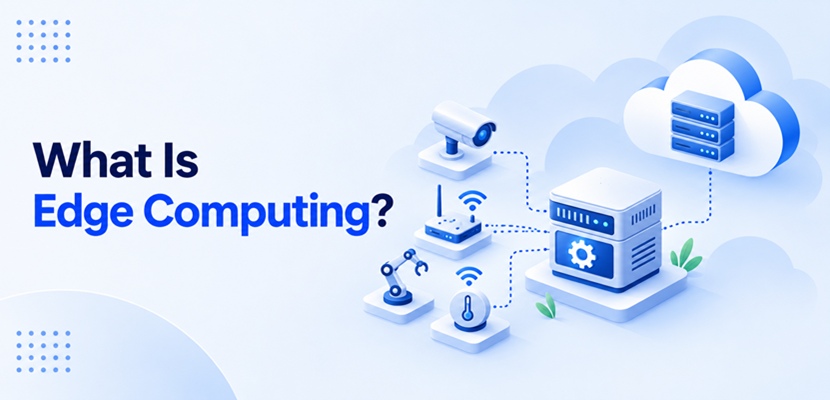
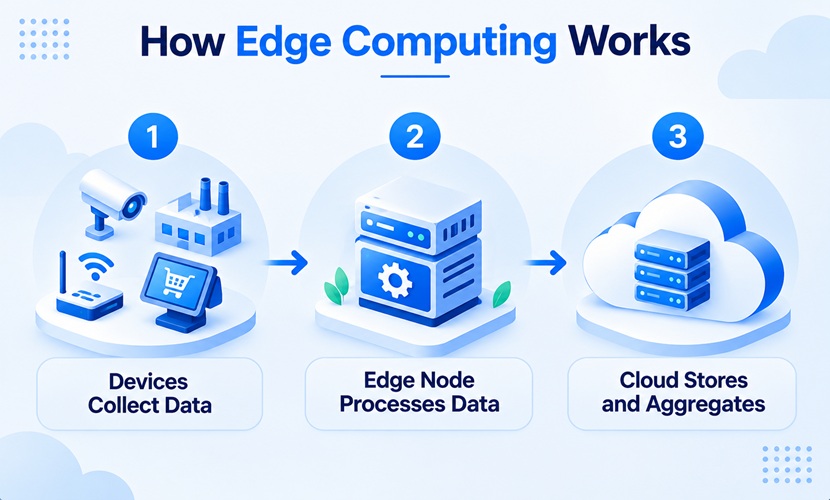
An edge deployment splits processing between the site where data originates and central infrastructure. Its core component is the edge node, a device, server, or gateway that processes data close to where it is generated. A typical edge data flow has three stages:
- Devices collect data. Sensors, cameras, and point-of-sale terminals capture readings and events and send them to a nearby edge node, such as an edge server or a gateway that links local devices to the wider network.
- The edge node processes data. The node filters and analyzes incoming data, triggers immediate actions, and summarizes or discards data that does not need to leave the site.
- The cloud stores and aggregates results. Summaries, alerts, and selected records move to a corporate data center or private cloud, which handles long-term storage, cross-site reporting, and machine learning model training.
This division keeps time-sensitive decisions at the edge, while central infrastructure handles work that benefits from scale and a view of all locations.
Edge Computing vs. Other Computing Models
Edge computing is closely related to cloud computing, fog computing and the Internet of Things (IoT). The terms describe related ideas, and vendors sometimes use them interchangeably. Comparing them clarifies where edge computing fits in a larger system and which role each technology plays.
Edge Computing vs. Cloud Computing
Cloud computing centralizes processing and storage in hyperscale data centers that serve users over the internet, while edge computing processes data closer to where it is generated. The two models differ in how they handle response time requirements and large data volumes, and in how they scale resources. The table below summarizes the differences:
| Edge Computing | Cloud Computing | |
| Processing Location | At or near the data source. | Centralized data centers. |
| Response Time | Low, since data travels a short distance. | Higher, depending on the distance to the data center. |
| Data Movement | Most raw data stays local. | Data travels to the provider's data center. |
| Scale | Limited by the resources at each site. | Large pools of resources available on demand. |
| Suitable Workloads | Real-time control, local analytics, and offline operation. | Storage, large-scale analytics, and model training. |
Edge and cloud computing complement each other. Edge deployments rely on the cloud for central management, data aggregation, and long-term retention, while the edge handles real-time processing.
Edge Computing vs. Fog Computing
Fog computing adds a layer of distributed nodes between end devices and the cloud. The fog nodes are physical or virtual resources that provide processing, storage, and networking services close to end devices while remaining connected to central cloud services.
In the National Institute of Standards and Technology (NIST) model, edge computing is the layer that contains end devices and their users, while fog nodes sit between that layer and the cloud. Fog nodes can aggregate data from several edge locations and run workloads too large for a single device. In practice, the distinction between the two is not fixed, and many vendors use "edge" for both layers.
Edge Computing vs. IoT
IoT refers to physical devices, such as sensors, meters, and connected machines, that collect data and exchange it over a network. Edge computing determines where that data is processed. An IoT device can send readings directly to the cloud with no edge layer, while an edge deployment can process data from sources other than IoT devices, such as video feeds.
The two technologies are often combined because IoT deployments generate data streams that are slow or costly to transmit in full. This combination, known as IoT edge computing, processes device data on local servers and gateways, which shortens response times and reduces network traffic.
Types of Edge Computing
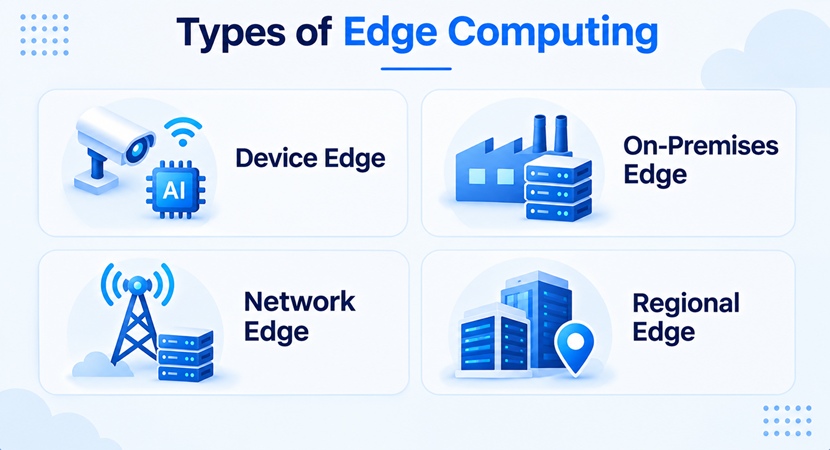
The edge has no single physical location. Processing can run anywhere from inside the device that generates data to a regional data center. Each location offers a different balance of response time, available resources, and management effort, and a single deployment can combine several of them.
Device Edge
Device edge computing runs directly on the hardware that generates or collects data, such as a smart camera, an industrial controller, or a vehicle's onboard computer. Processing on the device removes the network trip entirely, making this type suitable for decisions that must happen within milliseconds.
Because devices have limited processing power, memory, and storage, device edge workloads are lightweight tasks, such as filtering sensor readings or running a compact artificial intelligence (AI) model.
On-Premises Edge
On-premises edge computing uses servers or gateways installed at the site where data is generated, such as a factory floor, a retail store, or a hospital. This hardware gathers data from many local devices and offers more resources than the devices themselves. Common on-premises edge workloads include:
- Local analytics. Sensor and video data are processed to detect events at the site.
- Equipment control. Machines are adjusted or stopped based on incoming readings.
- Data filtering. Raw data is summarized or discarded before anything is sent to the cloud.
- Local services. Applications remain highly available when the internet connection drops.
Because the hardware sits on the organization's premises, the organization controls the data and is responsible for maintaining the equipment.
Network Edge
Network edge computing runs on infrastructure operated by a telecom or network provider, such as equipment at cell towers or local aggregation sites. Multi-access edge computing (MEC) is an architecture standardized by the European Telecommunications Standards Institute (ETSI). The MEC standard defines how providers offer cloud computing capabilities and an IT service environment at the edge of their networks. MEC applies to cellular, Wi-Fi, and fixed-line access networks.
The network edge suits workloads that serve many mobile or distributed users, such as connected vehicles or live video. Organizations use the provider's infrastructure instead of installing hardware at each location.
Regional Edge
Regional edge computing uses smaller facilities, located closer to users than a central cloud region, often in the same metropolitan area. Content delivery network (CDN) points of presence, which cache and serve content near users, are a common example, and many of them also run application code. The regional edge provides more resources than on-site hardware at the cost of a slightly longer network path, making it suitable for workloads that serve users across a city or region.
Benefits of Edge Computing
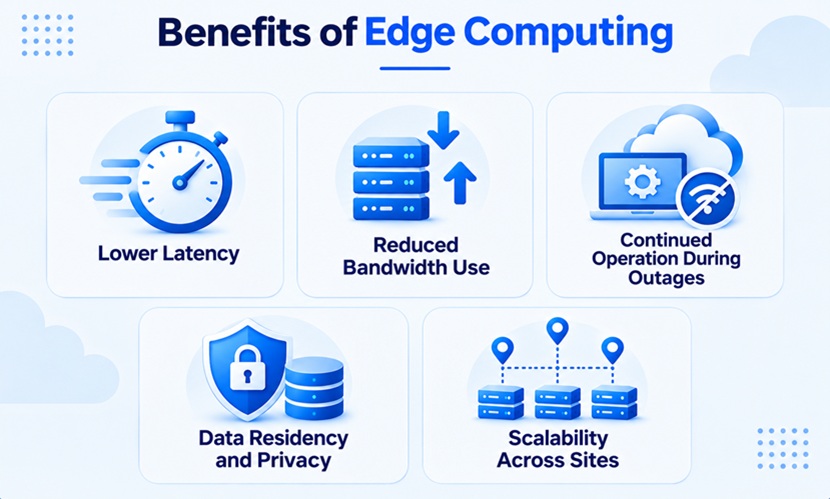
Moving processing closer to the data source changes how quickly a system reacts and how much data crosses the network. It also changes where sensitive data is stored and how the system behaves when a connection fails. The key benefits of edge computing include:
- Lower latency. Data travels a short distance before processing, so applications respond faster. This benefit is especially important for equipment control, safety systems, and interactive applications.
- Reduced bandwidth use. Edge nodes filter and summarize data before forwarding it, which reduces the traffic that crosses the WAN and the associated data transfer costs.
- Continued operation during outages. Local systems continue processing data and controlling equipment during a cloud outage and synchronize once the connection returns. The cloud connection is no longer a single point of failure for local operations.
- Data residency and privacy. Sensitive data, such as patient records or video footage, can be processed and stored on-site, with only anonymized or summarized results leaving the location. This approach supports compliance with data protection laws such as the General Data Protection Regulation (GDPR).
- Scalability across sites. Each new location brings its own processing capacity, so central infrastructure does not need to increase in proportion to the number of devices.
The size of each benefit depends on the workload. Applications without strict timing requirements or large data volumes gain less from edge processing, which is why edge computing complements the cloud instead of replacing it.
Edge Computing Use Cases
Industries adopt edge computing when data originates in physical locations and when delays or lost connections carry operational or safety risks. Deployments range from a single gateway in a store to large networks of nodes run by telecom providers. Common edge computing use cases include:
- Manufacturing. Sensors and cameras on production lines send data to local systems that detect defects, track equipment condition, and predict failures before they cause downtime.
- Retail. Stores analyze data from cameras, shelf sensors, and point-of-sale systems to track inventory, and checkout systems can continue accepting payments during internet outages.
- Healthcare. Hospitals analyze data from patient monitors and imaging equipment on hospital servers, which shortens response times and keeps patient data inside the hospital network.
- Transportation. Vehicles process sensor data onboard for driver assistance features, while roadside and network edge systems support traffic management.
- Energy and utilities. Remote sites such as wind farms, substations, and pipelines rely on local processing to monitor equipment and respond to faults where connectivity is limited.
- Telecommunications. Network operators use network virtualization to run network functions and customer applications at the network edge, closer to mobile users.
- Media and gaming. Content providers store video and host game servers at regional edge locations to reduce buffering and delays for viewers and players.
In each industry, the edge handles local processing, while a central environment collects data from all locations for reporting, analysis, and storage.
Challenges and Limitations of Edge Computing
Operating infrastructure across many locations introduces problems that a single data center does not face. Edge hardware often sits in places without on-site IT staff, controlled physical access, or a reliable network connection. The main challenges of edge computing include:
- Larger attack surface. Each edge node is a potential entry point for cyberattacks, which expands the organization's attack surface. Hardware in public or remote locations is also exposed to physical tampering.
- Management at scale. Deploying updates, applying security patches, and tracking the health of a large number of distributed nodes requires automation and centralized monitoring.
- Limited resources. Edge hardware has less processing power, memory, and storage than a data center, which limits the size of the workloads it can run.
- Data consistency. Unreliable connections can delay synchronization, leaving edge sites and the central environment with different versions of the same data.
- Hardware and maintenance costs. Equipment at many sites adds upfront capital costs and ongoing operating expenses, including power and cooling and the replacement of failed devices.
- Lack of standardization. Edge hardware, protocols, and management platforms vary between vendors, which complicates integration and increases the risk of vendor lock-in.
Organizations can reduce many edge computing challenges with central management tools, standardized hardware, and security policies that apply to each node.
When to Choose Edge Computing
Edge computing suits workloads that gain from processing near the data source. The decision rests on how quickly the workload must respond, how much data it produces, and where that data is allowed to go. Edge computing is a strong candidate for workloads that:
- Require immediate responses. Control systems, safety alerts, and other mission-critical applications depend on responses faster than a round trip to a distant data center allows.
- Generate large data volumes. Video streams and high-frequency sensor readings are costly to transmit in full, and local filtering sends only the relevant data.
- Run with limited connectivity. Ships, mines, and remote facilities must continue operating when the network link is slow or unavailable.
- Handle restricted data. Information that must remain within a facility or country can be processed where it is created.
Because an edge deployment adds hardware and management work, cloud infrastructure remains the better choice for workloads without strict timing requirements, such as batch analytics, backups, and web applications. A common approach combines the two in a hybrid cloud setup, with time-sensitive tasks at the edge and other workloads in the cloud.
Getting Started with Edge Computing
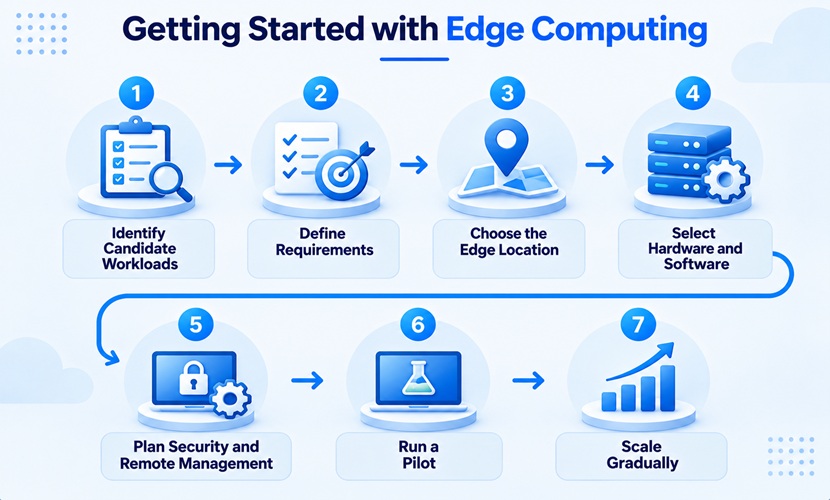
Edge projects involve hardware, software, and operations at locations the IT team may rarely visit. Planning before procuring equipment prevents costly changes later, and a small first project shows whether the approach delivers the expected results. The following steps outline a typical path to a first edge deployment:
- Identify candidate workloads. List the applications that need faster responses, produce large data volumes, or must keep running offline.
- Define requirements. Set targets for response time, data retention, and security for each workload.
- Choose the edge location. Match each workload to the edge type that meets its requirements.
- Select hardware and software. Choose equipment rated for the site's power, space, and environmental conditions. Select a server software stack, including the operating system and container runtime (the software that runs containers), that supports remote management.
- Plan security and remote management. Define how nodes are provisioned, updated, and monitored without on-site staff.
- Run a pilot. Deploy the workload at one site and measure the results against the requirements.
- Scale gradually. Extend the deployment to more sites with automated provisioning and standard configurations.
A successful pilot gives the team a tested configuration to reuse at each new site, which shortens later rollouts and keeps sites consistent.
Edge Computing Architecture Considerations
Designing for the edge extends the principles of hybrid cloud architecture to many smaller locations, from individual devices to a central cloud. Decisions made at the design stage determine how easily workloads move between tiers, how data stays consistent, and how the organization manages each node. The key edge computing architecture considerations are:
- Workload placement. Each task runs at the tier that matches its timing and resource demands. Time-sensitive decisions are processed at the edge, while data aggregation and model training take place in the cloud.
- Consistent runtime. Virtual machines and containers package applications so the same workload runs on edge nodes and in the cloud. Container orchestration platforms deploy and update these workloads across all sites from one place.
- Data synchronization. Edge nodes store data locally and synchronize it with central systems on a schedule or whenever a connection is available, following defined rules for resolving conflicts.
- Connection to central infrastructure. Encrypted connections, such as software-defined WAN (SD-WAN) tunnels, join edge sites to the cloud or data center that manages them.
- Security at each tier. Encryption at rest protects data stored on edge nodes, and encryption in transit protects data moving between sites. Authentication for each device and zero trust access controls, which verify each connection request and limit access to nodes outside a secured data center.
The central tier completes the architecture. It receives data from all edge sites, hosts the tools that manage the nodes, and runs processing that is too resource-intensive for edge hardware.
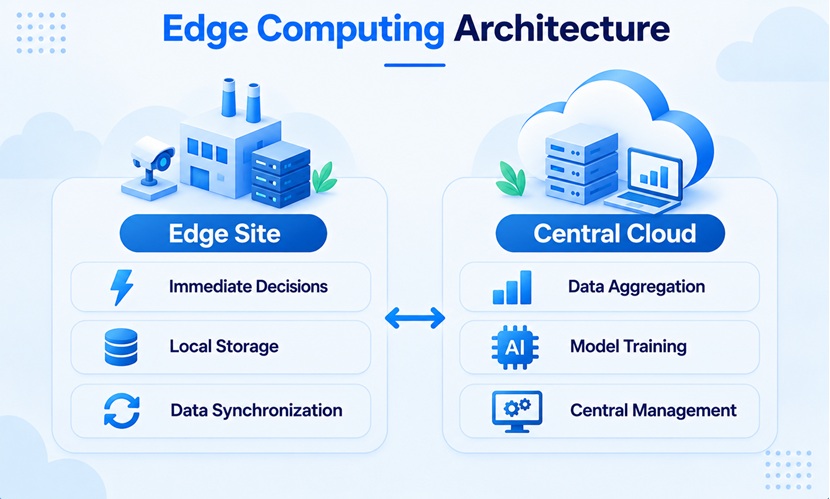
Note: Edge sites depend on a central location that collects their data and runs resource-intensive processing. phoenixNAP's Bare Metal Cloud is a dedicated server with the flexibility of the cloud. Its single-tenant hardware can host this aggregation and analytics tier, and API-driven provisioning lets the organization add or release resources as the number of edge sites changes.
The Future of Edge Computing
More capable hardware and faster networks continue to expand what runs outside the data center. Recent developments focus on running demanding workloads at the edge and managing them with the same tools organizations already use in the cloud. The main edge computing trends include:
- AI inference at the edge. Inference, the step in which a trained model makes predictions on new data, increasingly runs on edge devices and servers. Images, audio, and sensor data are analyzed where they are captured instead of being sent to the cloud.
- 5G and MEC. Telecom providers pair 5G networks with MEC platforms to offer low-latency processing to mobile and connected devices.
- Kubernetes at the edge. Lightweight Kubernetes distributions such as K3s and edge frameworks such as KubeEdge extend container orchestration to edge nodes, an approach known as cloud-native edge computing.
- Confidential computing. Trusted execution environments (isolated areas of a processor that other software cannot access) protect data in use on edge hardware in unsecured locations.
- Edge as a service. Providers offer edge hardware and platforms through subscription models, letting organizations deploy edge capacity without a large upfront investment. Distributed cloud services follow the same model by extending public cloud resources to edge locations.
These developments follow wider cloud computing trends, with edge and cloud environments sharing more of the same tools, which simplifies moving workloads between them.
Edge Computing FAQ
Edge computing overlaps with several established technologies, so the same questions arise frequently. Most concern its relationship with the cloud, what it looks like in practice, and how it affects data protection.
Is Edge Computing Replacing Cloud Computing?
No, edge computing complements cloud computing rather than replacing it. The edge handles latency-sensitive processing near the data source, while the cloud provides central management, large-scale analytics, and long-term storage for data from all edge sites.
What Is an Example of Edge Computing?
A smart building system is a common example. Local controllers process data from occupancy and temperature sensors to adjust heating, cooling, and lighting in real time, and send only energy usage summaries to a cloud platform for reporting.
How Does Edge Computing Improve Security and Privacy?
Edge computing keeps sensitive raw data on-site and sends only processed or anonymized results over the network. Less data in transit and in central storage means less data exposed if a data breach occurs. However, each additional node expands the attack surface, and the security benefits depend on encryption of stored and transmitted data, strict access controls, and regular updates on each node.
Bringing Processing Closer to the Data
Edge computing moves processing to the locations where data is created, giving time-sensitive applications faster responses and reducing the data sent across the network. Combined with central cloud infrastructure, it supports systems that react locally while still benefiting from analysis at scale. Start by reviewing your workloads for strict response time requirements, high data volumes, or unreliable connectivity, and run a pilot at a single site to test the approach.